
Our Approach
Capacity development is the work of strengthening the people, systems and institutions. For the IMCS Network, it is not a single activity. It is a connected set of efforts that build individual and collective capabilities and contribute to a stronger global community. To do that effectively, we must take a considered approach to how we undertake our capacity development work.
Our capacity development work includes:
- Wavemakers - a professional development programme that support individuals over time.
- Online learning through the IMCS Network Learning Portal, which hosts courses, reference materials and applied resources that members can use at their own pace and adapt to their context.
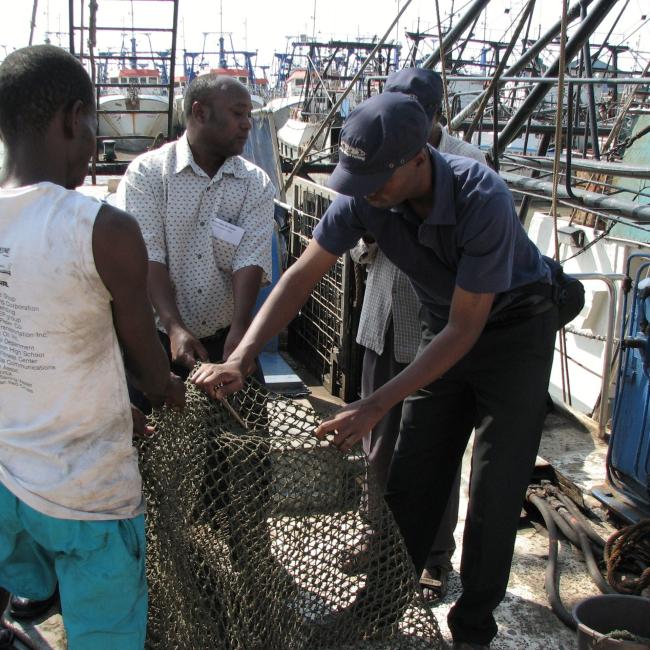
- Workshops, trainings and applied exercises that the Network develops, co-designs or contributes to, grounded in real cases and operational decision making.
- Peer exchange across the membership, including the Tuna Compliance Network and the Pan-Pacific Fisheries Compliance Network, where individuals learn from each other and work through shared challenges.
- Resources and guidance developed for the field, such as inspection manuals, technical briefs and reference materials that support consistent practice across regions.
Why it matters
Fisheries MCS, compliance and enforcement capacity development only works when it is practical, contextual and designed to change practice. Too much capacity development work is donor driven, presentation heavy, repetitive, and disconnected from follow up. Surface-level training does not allow participants to engage deeply with content, apply it to their own work, or retain information beyond the training event. This wastes limited time and funding for both the participants and the trainers and can undermine trust.
The IMCS Network’s role is to strengthen capabilities through active learning that is needs driven, applied, and demonstrably useful.
Our aspiration
The IMCS Network will be the trusted global reference point for fisheries MCS, compliance and enforcement capacity development. We will shape a consistent standard for quality and relevance, connect efforts across regions and partners, and build learning approaches that reduce duplication, strengthen local ownership, and lead to measurable improvements.
Principles
| Principle | What it means |
| Needs driven and grounded in reality | We only engage where there is a clearly defined operational need, shaped by national and regional priorities and real world constraints. We start with task and gap analysis before design decisions are made. |
| Active learning only | We do not support passive learning environments. If an activity is primarily presentation based, we will either reshape it into active learning or we will not participate. IMCS Network engagement must involve applied learning methods such as scenarios, simulations, case based problem solving, and structured peer exchange. |
| Designed for real world application | Learning must reflect operational realities, legal context, institutional roles, and constraints. We prioritise real cases and practical application over abstract concepts or generic presentations. |
| Prepared participation | Participants should arrive ready to engage. Where there is an in-person component, it should be supported by pre engagement materials that build a shared baseline and enable more advanced applied work during live sessions. |
| Alignment and duplication | The Network actively reduces duplication by connecting capacity development efforts across agencies, organisations and regions, and by promoting shared approaches, shared resources, and complementary roles. |
| Diverse expertise and representation | Capacity development should reflect the community it serves. We diversify trainer perspectives, centre practitioner experience, and avoid defaulting to Western-led delivery models. |
| Follow up and measurable impact | Training without follow up is not capacity development. We require proportionate impact measurement and agree that follow up will focus on changes in practice, not only participation or satisfaction. |
The IMCS Network check
Is there a clearly defined operational need and intention to drive change?
Does the capacity development clearly define learning outcomes and is the material designed to ensure success or achievement of these outcomes? If not, can we influence it?
How will alignment be ensured and duplication avoided across existing efforts?
Is the approach grounded in real cases and local context?
What preparation is required before any live engagement?
What follow up will demonstrate impact?
This helps us assess how we engage, who we need to connect with and infoms design, delivery and follow-up of any capacity development work that we do.
Want to work with the IMCS Network or learn more, please email us at connect@imcsnet.org